

By Mark Rossano (Originally Published Mar 5th, 2021)
Over the past few years, the U.S. has experienced a number of supply shocks, including a heparin shortage (due to swine flu) and most recently, drastic shortfalls in PPE and semiconductors. In an effort to take stock of the U.S.’s preparedness, President Biden has initiated a review of vital supply chains for U.S. government agencies, which will focus on medicine, rare earths, semiconductors, large capacity batteries, and other “high value”—or strategically important—assets. The underlying goal is to identify choke points, concentration to single suppliers, and potential supply shortfalls (semiconductors). He also wants to secure strategic reserves for items pivotal to national security (i.e. rare earths are in everything from Patriot Missiles and drones to cell phones).
But the narrative was always going to shift more broadly to China after the presidential election, regardless of the outcome. And what this review really provides is an opportunity to highlight just how levered we are to China, and the importance of diversifying and supporting allies in that region. His focus on supply chains will identify the importance of Taiwan and other Asian nations while highlighting the leverage China holds over key U.S. supply lines. China also faces their own problem: “How do you replace your largest customer?” They need their own diversified customer base as the rhetoric moves further into action territory with trade partners (i.e. the U.S. and Australia). President Xi has been on the phone to reassure trade partners, but also to stress the importance of their sovereignty and respecting boundaries. But Xi knows this won’t be enough and is the underlying fundamental reason the “Dual Circulation Strategy” is pivotal for the next leg of Chinese growth. They require robust domestic consumption, which has been fleeting over the last few years. As exports come under pressure with rising global competition and sanctions, China is going to need to sell more locally—cutting their dependence on international markets and technology.
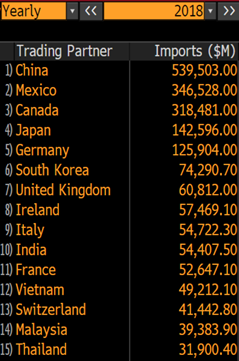
The U.S. imports more from China than any other country in the world (see below charts that highlight just how much). These dollar amounts come from a mixture of finished and semi-finished goods, which creates a growing problem as underlying tensions aren’t going away . . . only getting worse. Just Thursday, the U.S. State department said that Japan and the U.S. have “reiterated their strong opposition to unilateral attempts to change the status quo by force or coercion in the East and South China Seas, exchanging views and sharing their deep concerns over the PRC’s Coast Guard Law.” Essentially, China has enacted a new law that authorizes the Chinese coastguard to fire on foreign ships operating in disputed waters claimed by Beijing in the South China Sea and the East China Sea. Their aggressive shift is real and Biden is trying to be a bit more diplomatic than Trump was by building a case on China. But it will end the same way . . . by changing supply lines and pushing to strengthen alliances around the world—especially in Asia.


At the start of the 2016 election, we were already facing deteriorating relations with China (check out more on this in my previous Flamethrower article “China: Friend or Foe”). President Obama introduced the “Pivot to Asia” and gathered declassified intelligence that built an airtight espionage case against China and several state-owned enterprises. This included the espionage of Huawei installing backdoors into their equipment, which would be a huge problem if it were put in a server at the Pentagon or other sensitive site. Many countries have followed the U.S. model of restricting their products in any area of significant importance and telecommunications. So far, every member of Biden’s team has said all the right things. Most recently, new U.S. Commerce Secretary Gina Raimondo said “Chinese telecom companies—their behavior is a threat to American economic and national security. We’re going to use (the entity list) to its full effect.”[2] So even with a new administration in office, the course clearly remains the same.
Costs of operations are inherently rising in China, and now with the Chinese Communist Congress taking place, President Xi is doubling down on the Communist playbook. Xi has initiated several “education” campaigns to revive faith in the Party Ideology:
• “We must educate and guide the whole Party in understanding how, through the extraordinary experiences of the Party, Marxism has profoundly changed China, and profoundly changed the world.”
• In particular, it is necessary to deeply study and understand the Party’s theoretical innovations in the new era in the light of the historical achievements and changes in the cause of the Party and the state since the 18th Party Congress.[2]”
Ultimately, his five main goals are:
• Being loyal to the party
• Combining theory with practice
• Serving the People
• Engaging in reflection and self-criticism
• Daring to struggle (Xi elaborated :“Struggle is what got our party to where it is today, and we must rely on struggle to win the future.”)
Xi is pivoting away from the Deng mantra of “let some get rich first.” The CCP is paying more attention to how wealth is being distributed throughout their society and how to increase domestic consumption to become more self-sufficient under the Dual Circulation Strategy. The “education” campaigns are rising, with more “structural” change to come following the FYP or 14th Five-Year Plan and GWR (Government Work Report).
According to Trivium, President Xi is framing many of these struggles against malicious forces abroad and subversive elements at home, which will only put more pressure on companies operating within the regime. Biden’s review provides a perfect cover to promote investment to “friendly” nations while the rhetoric worsens between China and the U.S.
A natural progression following the “Pivot to Asia” was a trade war or a growing cold war mentality positioning against expansion. The below chart breaks down where we sit on what was purchased vs. agreed upon in the Phase One trade deal with China. Tariffs came along with the Trump presidency, and so far, there has been little change from Biden on that front. “Weeks before the White House said it would keep tariffs in place on more than $350 billion in Chinese goods, Katherine Tai previewed the bad news to a group of U.S. business leaders. Tai, who is President Joe Biden’s pick for U.S. Trade Representative, told executives at a private meeting hosted by the Business Roundtable last month that lobbying for the duties to be removed wouldn’t work, according to people familiar with her remarks. Instead, companies keen to keep the so-called phase one trade deal—struck by the Trump administration and Beijing—should be prepared to live with the tariffs too, Tai said.”[3] Katherine Tai was approved with bipartisan support as she has spent her career being “tough on China,” and is in a key position to keep pressing on unfair trade practices and securing a more balanced backdrop.

So far, China is closer to the target number, driven by their large purchases of agriculture.


So what does this have to do with microchips—or semiconductors? Why should the U.S. care? President Biden has asked Taiwan to “do more” to close the shortage in semiconductors, which is also a not-so-subtle way of telling China to back off Taiwan. We have outsourced a significant amount of fabrication to Taiwan and rely on them for a large portion of our technological capacity. With fabrication comes a slew of sensitive IP and materials that can’t fall into the wrong hands as it is a means of national security. This is a huge reason why Taiwan (and South Korea) are so important to us. President Xi has been in very public forums reiterating that the U.S. and our allies should stay out of Chinese affairs in Hong Kong, Tibet, Taiwan, and Xinjiang. The foreign minister Wang Yi also delivered a very similar statement:
• Stop undermining China’s sovereignty over Hong Kong, Xinjiang, Tibet, and Taiwan
• Remove unreasonable tariffs on Chinese goods and restrictions on Chinese technology companies.
• Lift restrictions on Chinese cultural groups and media outlets operating in the U.S. and on Chinese students studying at American universities.
President Biden responded with an Executive Order: “The order states that ‘working with allies can lead to strong, resilient supply chains,’ suggesting that international relationships will be central to this plan. Washington is expected to pursue partnerships with Taiwan, Japan and South Korea in chip production and Asia-Pacific economies including Australia in rare earths.”[4] Taiwan is a very important part of the U.S. technological supply chain from a military and government standpoint, but also to the everyday consumer.
Over the years, the U.S. has focused more on chip design, software, and intellectual property than the actual building of the asset. The U.S. has fallen behind in chip manufacturing, but we are still a vital part of the process.


We create the equipment, design, and software, each with their own IP that is a means of national security. These are assets that we will protect but are open to sharing with allies. In the same EO from President Biden: “The U.S. plans to share information with allies on supply networks for important products and will look to leverage complementary production. It will consider a framework for speedy sharing of these items in emergencies, as well as discuss securing stockpiles and spare manufacturing capacity. Partners could be asked to do less business with China.” But didn’t China just sign the RCEP deal with Japan, Australia, South Korea, and the ASEAN 10? Just a reminder: the same day that Australia and Japan signed the RCEP deal, they also signed a treaty of mutual defense. (Guess who Japan’s main military force is . . . the U.S.!)

China has looked to increase their hardware and software manufacturing, including fabrication/innovation, because Xi has deemed it a means of national security. Their demand continues to rise internally for additional hardware, and with the potential for additional sanctions, China is trying to diversify supply chains under the Dual Circulation Strategy. Taiwan Semiconductor just built a facility for $7B over the course of 3 years and they estimate that within the next 10 years, it will take 5–7 years of construction and $10B for the same type of facility. Chips are getting more complex and everything in our daily life is now “connected.” China scrambled all of last year to purchase chips to front-run any sanctions, which took spare capacity out of the market. Now marry that with supply chain disruptions (short materials), logistics, and rising demand. President Xi has highlighted the advancement of technology as an economic necessity and a means of national security. In preparation for this week’s Communist Congress, he has made these comments about China’s latest economic and geopolitical shifts: [5]
• “International economic, technological, cultural, security, and political structures are undergoing profound adjustment, and the world has entered a period of turbulent change.”
• “In the future, we will face a more adverse external environment, and we must be prepared to deal with a series of new risks and challenges.”[6]
• Addressing vulnerabilities in the supply chain is a key goal of the Dual Circulation Strategy, the new economic framework introduced by Xi Jinping last year
• Devote more resources to developing new technologies, so that China is not dependent on foreign suppliers.
China has invested billions in the build-out of manufacturing capacity over the last five years, with many more investments underway, but their demand continues to grow as well. The below bar chart puts into perspective just how exposed different countries are to a disruption in the technology supply chain, and many of these countries are pivotal to the U.S.


Building a Semiconductor (or microchip) production facility isn’t as easy as throwing up four walls and calling it a foundry. It takes a slew of hi-tech machinery, sterile rooms, raw materials, and a rising amount of water (more on that below). The U.S. has IDM facilities that can handle all three pieces of the process, but we still need a large amount of chip capacity that originates in places such as Taiwan, South Korea, and Japan. Recently, some companies have announced plans to build new facilities in the U.S., but that will take years and still leave us short due to our rising demand. China is still well behind on the underlying capacity in Asia, but they will be closing that gap quickly over the next ten years.


While it is important to have the capacity to build them, a country still needs the raw materials to make that possible. Everything from rare earths, silica, quartz, copper, tin, and other ingredients of the recipe are vital to securing a redundant and stable supply chain. China has done an excellent job through the “Belt and Road Initiative” and “Made in China 2025”—furthered by the “Dual Circulation Strategy”—to build out their raw materials. They still control a large amount of rare earths, but the U.S. is investing in local mines, as well as in Canada and Australia, to diversify supply and limit damage from a restriction on rare earth exports. President Xi has updated their laws to make a ban on rare earth exports easier and quicker to enact, but so far they have avoided pulling this final trigger. Instead, they have increased quotas for 2021 . . . so no fear yet. But the worst thing the U.S. and allies could do is WAIT to act until an embargo, as Japan was caught flat-footed in 2010 when China restricted rare earths to their markets.

China has also positioned itself to corner the market for a substantial portion of the “green” movement and benefit from the global adoption of environmentally friendly solutions. China controls a large part of the lithium-ion battery supply chain, putting EVs (electric vehicles) in the cross hairs. Everything in today’s “connected” world seems to have a battery and a chip in it. They also control a huge part of the anode and cathode production process, and especially the battery cell manufacturing. Just based on the below chart: it is clear what President Biden is implying with a “review” of our supply chain and who he is talking about when discussing diversification.

The demand for water is also growing given the amount of water that is involved in chip manufacturing. The slow monsoon season in Taiwan and rising demand puts an additional strain on the process from a cost and environmental perspective. It also points to another reason President Xi is pushing for the Yangtze River Protection Law, which is home to farming and tech facilities—both things China is looking to expand. It will take time to devise ways to manage the basin and flood plain that was subject to record floods in 2020.


The U.S. has HIGHLY sensitive intellectual property in allied hands from outsourcing different aspects of the technology supply chain to other regions. Would China love to get their hands on it? What would they be willing to do to get this information AND expand their fabrication capacity? Taiwan and the ASEAN 10 are pivotal in diversifying supply chains and many are looking for ways to expand investment outside of China. But Taiwan is also an easy target for China to gather advanced technology and the means to build it.
The U.S.’s “Pivot to Asia” started under Obama, accelerated under Trump, and will only be expanded and enhanced under Biden. The current administration is saying all the right things, but we need action, and it has to come quickly. We can utilize some of the underpinnings of the CPTPP and RCEP trade deals as launching points to streamlining open trade. The RCEP deal was a big step forward for the ASEAN 10 countries because it offers a path to removing tariffs, customs, and other hurdles to cross-country activity. It can also be used as a framework to expand trade with other nations—specifically the U.S., Europe, and India. India and China remain in their own standoff along their mutual borders with economic/ trade warfare being waged.

So, for now, it seems like Taiwan will remain our “red line.” We actively have a trip force in the region, recently sold harpoon missiles to the military, and carried out Freedom of Navigation exercises through the Taiwan Strait following China’s repeated violation of Taiwanese airspace. Both China and the U.S. are like lions testing the electric fence, trying to find a weakness, and the first step is solidifying supply lines. We also need to project force against the rising encroachment of Chinese assets in the South China Sea. The U.S. has deployed THAAD (Terminal High Altitude Area Defense) in strategic locations and spent another $27.4B incorporating precision-strike missiles throughout the first-island chains alongside our other military equipment in the Indo-Pacific theater. Major tech companies (such as Apple) have already started moving manufacturing out of China and into Vietnam and India. Many apparel companies pivoted to Malaysia, Indonesia, and India early on, but the shift of technology is hard and complex—it takes a massive power grid to support the electricity consumption, raw materials, and extensive training of a workforce. All of this takes time, but the challenges facing the U.S. are real and growing. We have ignored them for far too long. We need to stop being myopic and recognize the importance of allies and strategic partnerships to avoid the worst possible outcome: the next World War.
[1] https://www.reuters.com/article/us-usa-china-trade-commerce/new-u-s-commerce-head-will-use-entity-list-to-full-effect-idUSKBN2AW22R?il=0
[2] https://mailchi.mp/3696b05e40a3/quelle-surprise?e=21cdcdff2c
[3] https://www.bloomberg.com/news/articles/2021-02-23/biden-s-trade-chief-tasked-with-reset-after-trump-tariff-chaos?sref=9yOLp5hz
[4] https://asia.nikkei.com/Politics/International-relations/Biden-s-Asia-policy/US-and-allies-to-build-China-free-tech-supply-chain
[5] https://triviumchina.com/2020/08/25/dual-circulation-explained-sort-of/
[6] https://mailchi.mp/2a5e0e623c48/dual-circulation-explained-sort-of?e=21cdcdff2c